

As an antique and vintage jewelry collector, walking into Hamilton Hill—land of clean lines and modernist design—once felt like I’d stepped into the wrong dimension. But after working here and getting to know the designers and materials up close, I realized something surprising: antique, vintage, and modernist jewelry aren’t opposites at all.
In fact, blending older pieces with contemporary designs opens up an entirely new universe of possibilities—one rooted in history, but very much alive in the present. Here’s why.
1. Today’s jewelry designers are inspired by all sorts of things, including the past.
Some references to past trends and techniques are obvious, while others are more subtle. If you’re into Art Deco pieces, Kai Hill Metalsmithing has you covered with her Deco Swing Studs; Schaffrath’s Calla ring could easily be read as Art Nouveau, with its flowing, nature-inspired curves. And some of Sheila Stillman’s work showcases an ancient gold granulation technique that dates back to 2500 BC and later resurfaced during the Etruscan Revival of the 1800s.
You’ll also find shapes that were popular centuries ago being reinterpreted by modernist designers today. Take the navette, for example: a shape with curved sides and pointed ends, like a little boat (which is exactly what navette means in French). Rings featuring diamonds clustered into a navette shape were extremely popular during the Victorian era. Berlin-based designer Carl Dau is responsible for a Hamilton Hill bestseller, the Navette Earrings, available in stainless steel or a combination of stainless steel and gold. I like to think of them as a gateway piece to collecting modernist jewelry.
Another Berliner, André Ribeiro (1953 – 2025), uses rubber as the foundation for his designs—a material choice that harkens back to vulcanite, patented in 1844 by none other than Charles Goodyear (yes, the tire guy). Vulcanite was often used as an alternative to more expensive materials and was especially common in mourning jewelry. Ribeiro’s pieces, however, are decidedly more joyful!
2. A one-note jewelry collection is no fun!
Personal style comes from mixing the things you love—colors, patterns, textures, shapes, and techniques—in a way that feels true to you. Variety is the spice of life…and your jewelry box.
While some pieces deserve to be the star of the show, others play extremely well with jewelry of all ages. A few of my favorite combinations include:
Stacking a Sethi Couture band with a Victorian snake ring:

Adding a Georg Spreng Blub charm to a sentimental jumble on an antique chain:
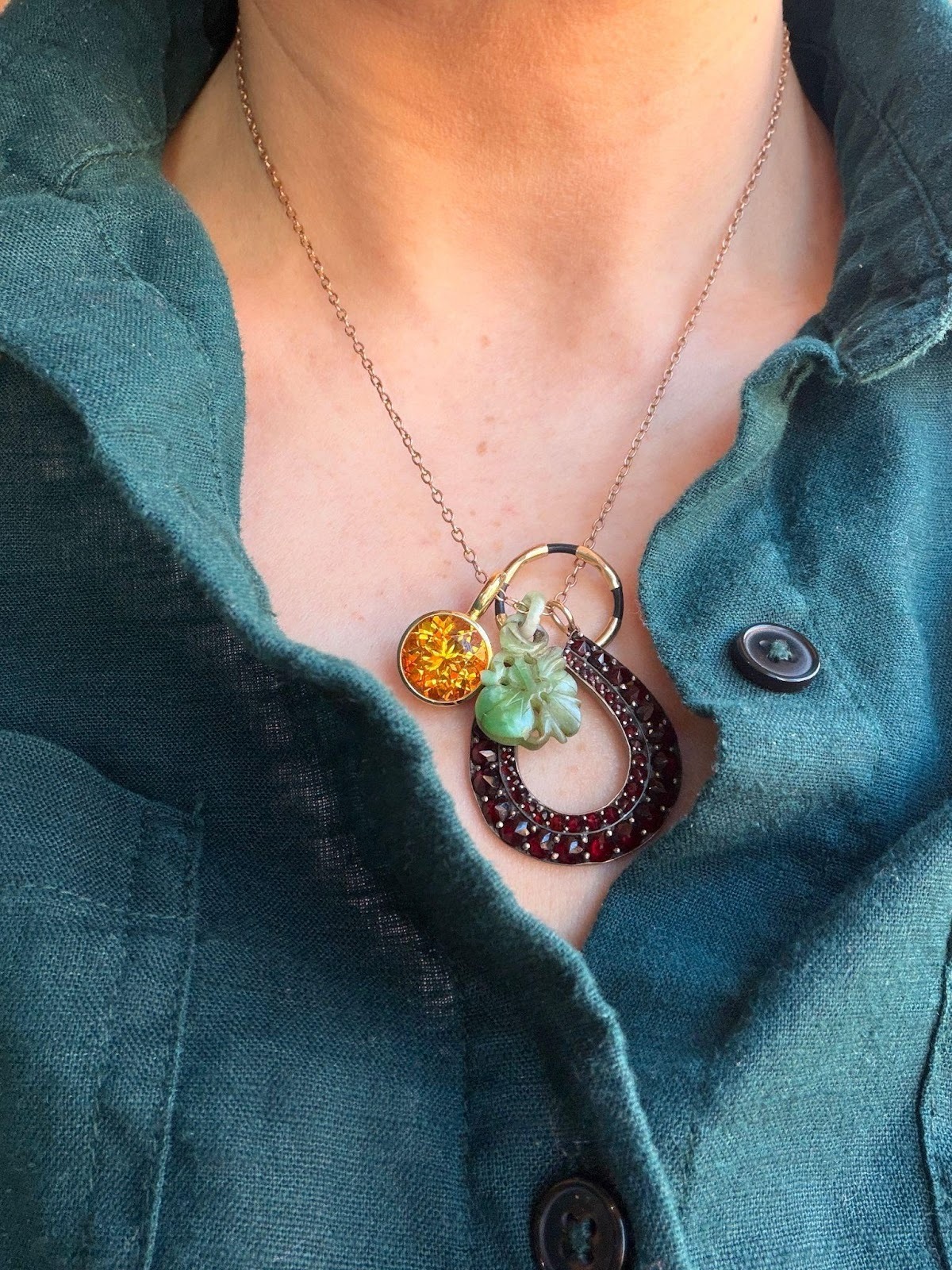
Stacking a Niessing Triple Colette bracelet with a classic vintage watch:

At the end of the day, jewelry is meant to be worn, enjoyed, and incorporated into your life. Mixing antique and vintage pieces with modernist design isn’t about breaking rules; it’s about creating a collection that feels personal, thoughtful, and a little unexpected.
Whether it’s a Victorian ring stacked with a contemporary band or sporting a centuries-old technique executed just last month, the conversation between past and present is what makes jewelry truly exciting. And once you start mixing, you won’t want to stop.
—Nina